

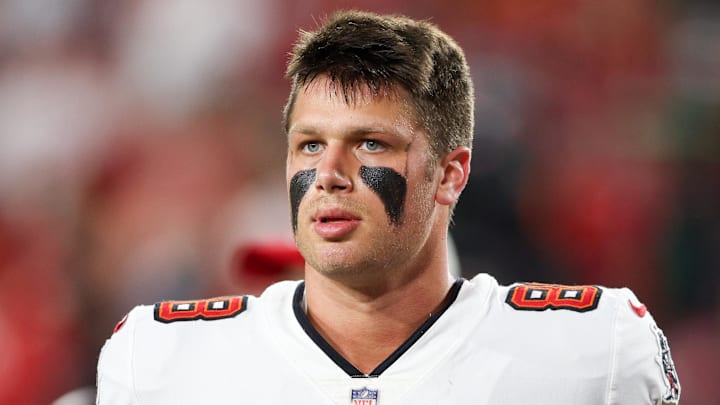
The Tampa Bay Buccaneers had a successful NFL Draft class, filling just about all of their major needs.
On defense, the pass rush got a major upgrade when the team drafted Miami’s Rueben Bain Jr. in the first round. They addressed the linebacker spot with Josiah Trotter out of Missouri, and the secondary added a versatile chess piece in Bain’s college teammate, cornerback Keionte Scott. They even added some depth to the defensive line with Clemson’s DeMonte Capehart.
On the offensive side of the ball, they added much-needed size and speed to the wide receiver room by drafting Ted Hurst out of Georgia State. They improved the interior offensive line depth by picking Notre Dame’s Billy Schrauth, and they closed out the draft by selecting LSU tight end Bauer Sharp.
The front office did a good job addressing needs, but there remains one major question about the roster heading into the 2026 season.
Buccaneers’ tight end depth is still a major weakness after 2026 NFL Draft
After hiring Zac Robinson as the new offensive coordinator, the expectation is that the Bucs will be running a lot of two tight end sets. Last season with Atlanta, Robinson ran 12 personnel at the second-highest rate of any play caller.
But for that system to work in Tampa Bay, they need to another reliable tight end to complement Cade Otton, and it's debatable if they did that during the draft.
The team drafted Bauer Sharp in the sixth round, but he’s a developmental piece whose likely path to a roster spot resides primarily through special teams.
He caught 66 passes for 576 yards and four touchdowns over the last two years, and does have a reputation for being a violent blocker. There’s a lot to be excited about, but after converting from quarterback to tight end just a few years ago, he’ll have quite the learning curve at the pro level.
The team likely would’ve preferred to add a more dynamic receiving threat that can make an immediate impact. NC State’s Justin Joly almost fell right into their laps in the fifth round, and the team was interested after holding an informal meeting at the combine and hosting him for a 30 visit.
But Sean Payton traded up just ahead of Tampa Bay to secure Joly for his Denver Broncos, and the Bucs missed out on a potential top target.
Behind Otton the team has Ko Kieft, Payne Durham, and Devin Culp. Kieft is a great blocker and special teams contributor, but he’s not an asset in the receiving game.
Durham and Culp combined for just two catches last year, so they haven’t proven to be viable receiving options.
Hopefully, Sharp proves the front office right for their belief in him. The team traded up in the sixth round in order to land him as the final piece of their draft class, so they clearly viewed him highly. If nobody outside of Otton can step up and make an impact at the tight end spot, it will be hard for Robinson to run his tight end-heavy scheme.
The Bucs could be forced to look toward free agency for a veteran that can stabilize the position while Sharp develops in his rookie season.
 Add us as a preferred source on Google